
Price influences who buys and how much of a service is consumed. In general, when services are very inexpensive, we expect that more people will purchase them, and when services are very expensive, they are considered exclusive and fewer people purchase them.
This rule also applies in health-related services as well as in dental and medical procedures. When certain brands of services are less expensive, they will attract more consumers than other, more expensive brands, especially if both sets of services have similar success rates or outcomes. This principle assumes that there is a market for both lower-priced and higher-priced services.In some countries, for certain services, prices may be controlled by government regulation.
With some exceptions, the higher you set the price of your service, the fewer customers you may have, and the lower you set the price, the more customers you may receive. This logic assumes that you have developed a service that customers want, and that you have effectively communicated your offer to the correct market segment, so customers know how and where to buy your services.
There is one exception to this general rule. There are certain types of one-of-a-kind, life-saving medical interventions with exceptional success rates for which the service provider can charge virtually any price. Such an example is pediatric oncology treatments for rare types of childhood cancers.
CROSS-BORDER PRICE DIFFERENCES
Price differences from one location to another, especially across national borders, can have an important impact on the willingness of consumers to travel from one place to another in order to consume health, wellness, dental, or medical services. Economists measure the cross-border value of currency in so-called Purchase Power Parity (PPP). Why is the price for the same thing on one side of the border different than on the other side?
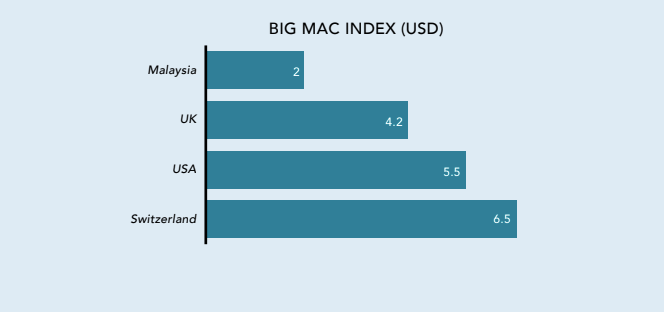
One measure of this cross-border price difference is the “Big Mac Index.” The Big Mac, of course, is the signature hamburger sandwich available at MacDonald’s, an international fast food chain. The Big Mac Index measures the cost of purchasing a Big Mac in different countries. After adjusting the various currencies to $US Dollars, the Big Mac price in Switzerland is $6.54, while it is $5.51 in the United States, $4.23 in England, and $2.10 in Malaysia. Does this mean that thousands of Big Mac fans from Switzerland will rush to Malaysia to purchase their Big Macs? Probably not. Less expensive hamburgers are probably not enough of a motivation to encourage consumers to travel to purchase them. Price differences do affect perception and may motivate or inhibit consumers of wellness, dental, health and medical services.
For example, if the wages, rent, and materials (costs) in a clinic or hospital in India are significantly lower than a comparable provider in a more developed economy, then health providers in India will be able to charge lower prices than in the more developed country and still realize a profit. Low price alone may not be enough to motivate consumers to travel for care, but lower prices can be an important part of the attractiveness of a provider or destination.
Similarly, dental and orthodontia prices in certain countries of the European Union (EU) are lower than in other countries. Because their costs are lower, dental clinics in Hungary and Croatia can charge lower prices than what similar clinics charge in Norway and the United Kingdom. With assistance from transportation and lodging businesses offering reliable and affordable complementary services, a good market for dental tourists has developed between the source location (Norway and the UK in this example) and the destinations (Hungary and Croatia).
WHEN “EXPENSIVE” IS SEEN AS BETTER
The lower price advantage does not always succeed. For example, the United States, Switzerland, the UK and other developed economies are very expensive overall. Their healthcare services are often extremely expensive compared to other locations. Some market segments of consumers equate expensive with high quality, and will seek out the more expensive service, if they can afford to, even if they have to compromise their spending on other
products and services. This approach may not seem logical; if a service is available at comparable quality for significantly lower price, why wouldn’t consumers flock to it? It is well documented that some customers will sacrifice to purchase the most expensive medical treatment they can possibly afford. And then there are the very wealthy who can afford anything they need or desire, regardless of price.
In healthcare, where the consumer’s physical or mental well-being is at stake, the cheap label can be counter-productive, driving away potential clients. Consumers do not associate high quality or good outcomes with cheap. The opposite may be true. Country brands or reputations can work in favor of health services. For services offered in Switzerland, customers expect high prices and high quality – mirroring what the country’s brand suggests.
The point is that lowering the price may not increase preference for your service, or the number of customers you receive. Depending on your marketing messages, images, and your offer, the low price may drive away potential clients.
Comparing published or nominal prices between and among countries is common in medical tourism, but this over-simplifies the situation. National policies and regulations, as well as insurance policies can have direct impacts on price levels, including VAT ratios or liability regulations. International patients may be exempt from paying VAT for medical services, and this can decrease their final price.
Price differences between countries may be due in part to liability and malpractice insurance requirements in one location, which do not apply across the border. These cost savings are great, as long as the treatment or procedure was successful. Should there be a bad outcome, and a malpractice claim, the healthcare providers will not be in the position to settle such claims and patients may pay higher prices in many ways.
| Tax regulation was recently changed in South Korea, allowing international patients to receive refunds of taxes on medical treatment fees. International patients who receive certain cosmetic surgery and/or procedures in South Korea can receive a VAT (10%) refund. Source: www.visitmedicalkorea.com |
Stay tuned for Pricing Your Services in Health Tourism, PT 2. We will talk about the difference between Price and Value, Need Versus Want, Price and Distance, and more.