
Strategic partnerships between hospitals are increasingly sought for financial sustainability. This is undoubtedly true in the US, although not exclusively. These potential alliances are often undertaken under the guise of improved efficiencies and better patient care. However, not all collaborations succeed. Understanding what makes healthcare partnerships work and why they sometimes fail can conserve public and private resources, guiding better decision-making.
The 2007 merger of two major for-profit hospital chains, Oschner and Tulane in Louisiana, serves as a cautionary tale. Despite what appeared to be impeccable planning and implementation, the merger failed to improve patient outcomes or boost profitability. The crucial lesson? Focusing solely on technological and operational integration cannot produce the desired result.
Similarly, the Penn State/Geisinger Health System merger collapsed because leadership failed to convince critical stakeholders of the merger’s anticipated value, and management caved to internal pressure, allowing duplicative programs to continue. This underscores the importance of stakeholder buy-in and eliminating redundancies, key strategic considerations.
The merger of Stanford and UCSF Medical Centers also failed, mainly because internal opinion leaders continued to identify with their legacy organizations rather than the merged entity. The expected clinical service consolidation never materialized, highlighting the critical importance of cultural integration v. financial aspirations. The cultural fit between two organizations may be far more predictive of success or failure than most other factors.
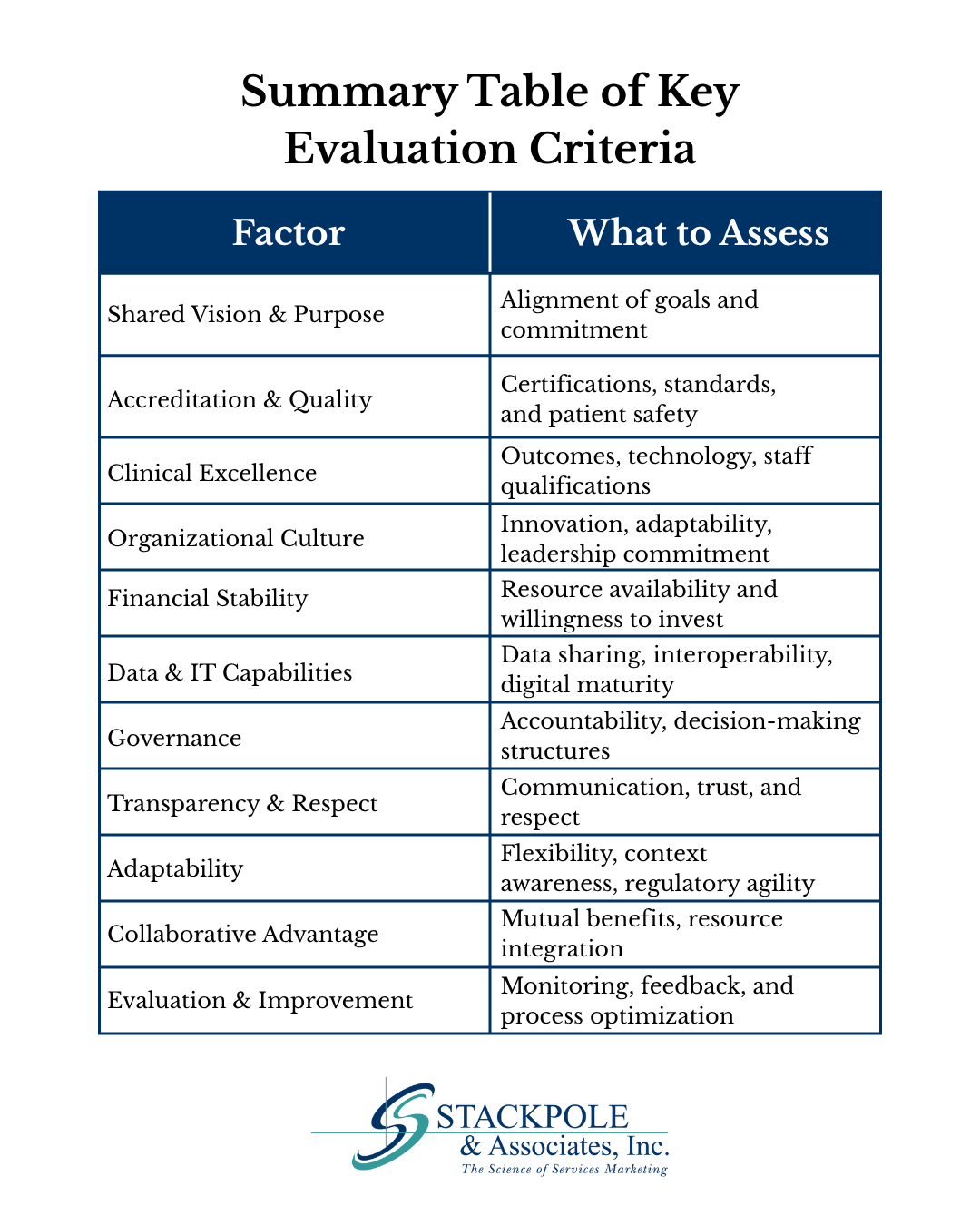
For successful healthcare partnerships, the following are critical:
- Mutual respect and transparency
- Clear governance and accountable post-merger leadership
- Aligned vision and purpose to drive stakeholder commitment
- True collaboration – before, during, and after – with robust participation
- Secure funding for the “soft costs” before the announcement
- Focus on outputs (patient outcomes, financial performance) rather than just inputs (labor costs, EHRs)
- Cultural compatibility between organizations
When the Royal Bournemouth and Poole Hospital Trusts in the UK attempted to merge, the Competition Commission blocked the merger, citing insufficient detail in the hospitals’ plans. This demonstrates that would-be partners must articulate clear, measurable benefits for stakeholders, especially patients.
Strategic and cultural alignment isn’t just desirable, it is essential for success.
At Stackpole & Associates, we help healthcare organizations build partnerships that work—strategically, operationally, and culturally.
If you’re exploring a merger, acquisition, or strategic alliance, don’t risk becoming another cautionary tale. Our team brings decades of insight into stakeholder engagement, cultural alignment, and market analysis to guide your success.
Let’s talk before your deal is signed.
Contact us to learn how evidence-based strategy can turn your vision into lasting value—for patients, staff, and your bottom line.