
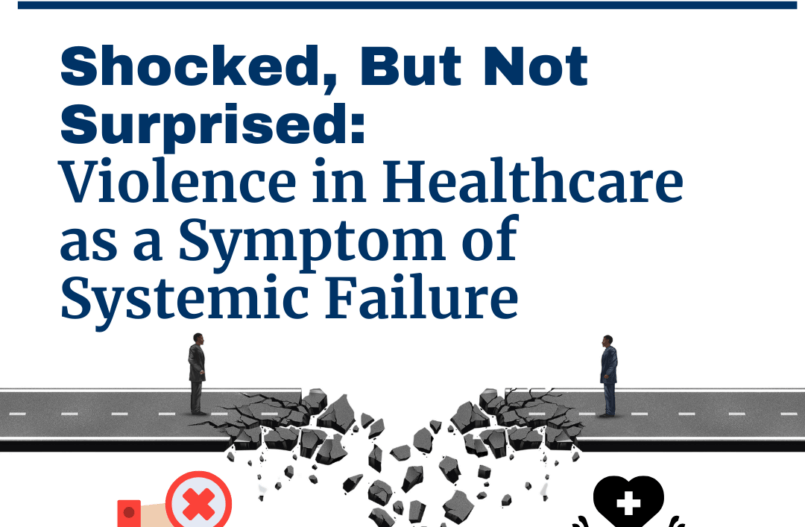
Violence in and around healthcare is far greater than generally reported and is escalating at an alarming rate. This phenomenon presents a new and deeply concerning political, operational, and cultural threat to the very institutions meant to protect and heal us. The recent assassination of UnitedHealthcare CEO Brian Thompson underscores the extent of public anger and despair over a healthcare system that many feel is not only failing but actively harming them.
This shocking incident forces a critical reckoning. The healthcare-industrial complex, long shielded by a veneer of professionalism, is now seen by many as dividing, damaging, and even killing those it purports to serve. As Warren Buffet once described, the U.S. healthcare system operates like a “tapeworm” on the economy. In their book, Deaths of Despair and the Future of Capitalism, Anne Case and Angus Deaton argue that the U.S. healthcare system is a net contributor to morbidity and mortality. The cracks in the system’s foundation have widened into chasms, and the violence directed at its symbols reflects this systemic failure.
A Flashpoint of Anger and Despair
The killing of Thompson revealed not just a heinous act of violence but an outpouring of public vitriol against an industry often perceived as prioritizing profit over people. Social media erupted with responses ranging from grief to outright glee, illustrating the pent-up frustration many Americans feel toward healthcare institutions. As Yolonda Wilson, a healthcare ethics professor at Saint Louis University, noted, “It’s not just anger. It’s pain—a deep, pent-up pain that hasn’t had a place to go.”
Dr. Helen Ouyang, an emergency physician, provides a firsthand account of this pervasive frustration in her New York Times essay. A critically ill patient once asked her if his insurance would cover his hospital stay—a question she couldn’t confidently answer. This uncertainty, Ouyang explained, compromises the fragile trust between doctors and patients. “The insurance unknowns don’t just undermine care,” she wrote, “they erode the very foundation of the doctor-patient relationship.”
This dynamic has become an unsustainable burden. As Bob Herman and Tara Bannow reported in STAT News, Americans’ trust in the healthcare system is at its lowest point in over two decades. Polling shows that while some Americans are satisfied with their insurance, those who use it most—patients with chronic or serious conditions—are the least satisfied. The system’s complexity, combined with financial and bureaucratic barriers, leaves millions uninsured or underinsured and many more fearful of the crushing debt that even insured care can entail.
A System That Breeds Desperation
The case of UnitedHealthcare illustrates the systemic issues fueling public rage. Critics have highlighted how insurers, including UnitedHealthcare, have employed artificial intelligence and algorithms to deny care, particularly for vulnerable populations. For example, older adults seeking rehabilitation have faced denials linked to technological decisions, not medical necessity. These barriers have tangible consequences, delaying or denying life-saving care and further eroding public trust.
Mark Fendrick, an internal medicine doctor and health policy expert, is quoted as saying: “We have more than enough money to take care of everybody, yet millions feel wronged by their insurance company.” For many, it’s not just the financial burden but the sense of betrayal by institutions that should be advocating for their health.
The Human Toll of an Inhumane System
The assassination of Thompson is a tragic, unacceptable act of violence. Yet, as Monica Bryant of Triage Cancer observes, it reflects a system perceived as inherently unfair. “The idea that someone who has health insurance can still be denied life-saving care feels fundamentally wrong,” she said. For people like Ty Beringer, a diabetic who has had to ration insulin due to costs, and Wilson, whose surgery was nearly derailed by administrative delays, the healthcare system often feels more like an adversary than an ally.
Ouyang describes the moral compromises doctors must make when insurance dictates treatment options, often forcing them to prescribe suboptimal care. “We call it ‘patient-based medicine,’” she explained, acknowledging the heartbreaking trade-offs between ideal treatment and financial reality.
Toward a Compassionate Response
Mary Haddad of the Catholic Health Association reminds us of the human cost of these failures. “We have to separate the person from the institution,” she said, speaking of Thompson’s murder. “This is a husband, a father—someone who lost their life. But the suffering within the system is real.”
As a society, we must confront the root causes of this violence. It is not enough to condemn the actions of an individual or the anger of a grieving population. We must address the systemic inequities that fuel this despair. The assassination of Mr. Thompson launched a welter of vitriol against insurance companies.
None of us should be surprised.
In the US, we’re armed to the teeth, angry and looking to vent deep-seated frustrations on some near-at-hand likely target. There is no ethical justification, but to slap a nurse who ignores our loved one in pain, or shoot an insurance executive who succeeds when we suffer shows an incremental degree of difference, but the motivational equivalence is clear.
The healthcare system needs reform—not just to reduce costs but to restore humanity, compassion, and trust to a sector that is failing the people it is meant to serve. Until then, the anger and despair driving these tragedies will remain a dark stain on the American healthcare system.