

For years, the biggest challenge in health tourism marketing has been getting in front of the patient at the exact moment they’re deciding where to go for care. That effort used to belong to Google searches, patient forums, and word of mouth. It’s about to belong to a chatbot.
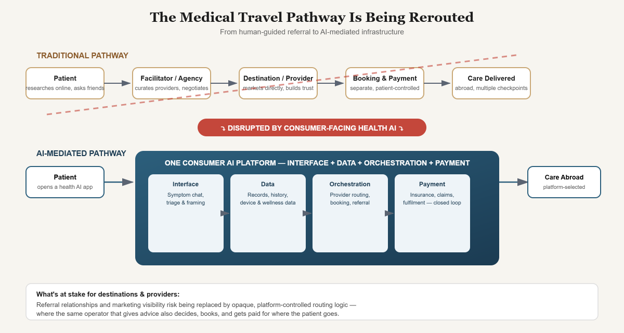
A new Nature Health perspective by researchers from University College London, Johns Hopkins, and Scripps lays out what they call the “infrastructure turn” in consumer health AI. The core argument: tools like ChatGPT Health, Amazon’s Health AI, Ant Group’s Afu, and Claude for Healthcare are no longer just answering health questions. They’re being wired directly into medical records, appointment booking, insurance verification, payment rails, and clinical workflow. In other words, they’re becoming the pathway itself — not a signpost pointing toward care, but the road, the toll booth, and increasingly, the driver.
For anyone in health tourism and medical travel, this should set off alarms in both a good and a concerning way.
The opportunity: closing the advice-to-action gap
The paper’s authors highlight a real, well-documented problem in healthcare generally: people get advice, but they don’t act on it. Appointments don’t get booked. Prescriptions don’t get filled. Care journeys stall out in the gap between “you should see a specialist” and actually seeing one.
Medical tourism lives inside that exact gap, except the gap is wider — it spans borders, currencies, visas, and unfamiliar provider networks. If AI platforms can shrink that gap by connecting consumer inquiry directly to booking and payment, that’s a genuine opportunity. A patient in a region with limited local access, told by an AI assistant that a procedure is available faster and more affordably abroad, could move from intent to a booked appointment in one conversation, rather than weeks of research. That’s the kind of friction reduction our markets have been chasing for two decades.
The risk: who’s doing the routing, and why
Here’s where it gets uncomfortable. The paper flags a structural conflict of interest that applies directly to cross-border care: when the same system that interprets a patient’s symptoms is also the one that recommends where they go, and profits from that recommendation, “advice quality becomes a structural conflict of interest via a closed-loop configuration.” Ant Group’s Afu — which triages, refers, books, and processes insurance payment all inside one app — is the paper’s clearest example of this loop closing completely.
Now map that onto international patient acquisition. If a consumer AI platform starts recommending destinations, hospitals, or providers based on which partners are integrated into its orchestration layer, rather than which providers are actually the best clinical fit, the “routing” that decides where patients go shifts from marketing and referral networks you can build relationships with, to algorithmic defaults you can’t see or negotiate with. The paper’s independent stress test of ChatGPT Health found it under-triaged over half of gold-standard emergencies, with inconsistent safety escalation — a sobering reminder that these systems are making high-stakes routing decisions well before their accuracy is proven, and well outside of what experienced, qualified humans would do.
For destinations and providers competing in this space, that’s a fundamental shift in the marketing landscape: the “front door” to your patient pipeline may soon be an AI interface whose routing logic is opaque, commercially incentivized, and way outside your control.
What this means for your health tourism strategy
The authors argue that governance needs to catch up to these systems before they become the default infrastructure for accessing care — and the same logic applies to how destinations and providers position themselves. A few implications worth thinking about:
- Transparency will become a differentiator. As patients (and regulators) grow wary of black-box routing, providers who can clearly explain their credentials, outcomes, and referral relationships will stand out from platforms that optimize for their own commercial loop.
- Data governance is now a trust signal. Cross-border patients are already anxious about where their health data goes. Providers who can speak clearly to data handling will have an edge as AI-mediated referrals raise the stakes.
- Your marketing can’t assume a human is still the last click. If AI orchestration layers increasingly make first-contact triage and routing decisions, your visibility strategy needs to extend beyond patients to the platforms making recommendations on their behalf.
This shift is still early, but it’s moving fast, and it’s exactly the kind of market disruption that rewards those who see it coming. Understanding how AI-mediated pathways will reshape patient acquisition, trust, and competitive positioning in health tourism is no longer optional — it’s strategic.
Stackpole & Associates has spent decades helping destinations, providers, and health tourism organizations build the research-driven strategy and marketing systems that win in shifting markets. Don’t wait to see how this plays out — get ahead of it. Book a strategic consulting appointment with our team today, and let’s map out what AI-mediated patient routing means for your positioning before your competitors do.