

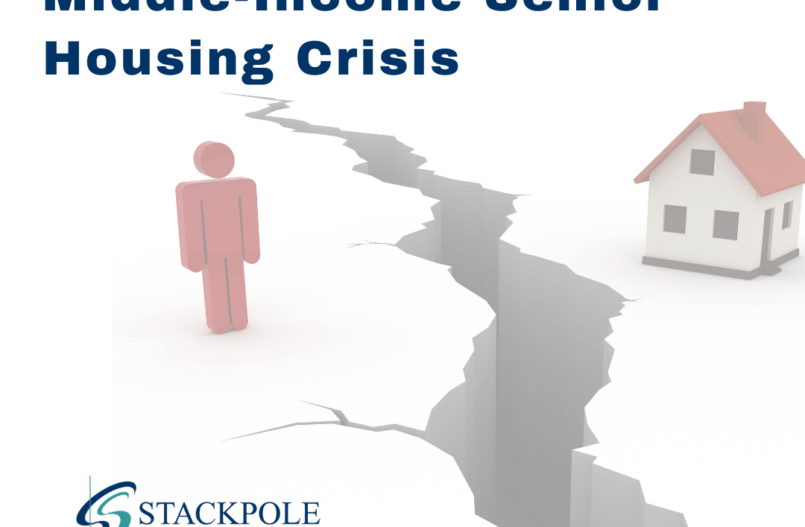
The “missing middle” in seniors’ housing refers to the lack of affordable options for middle-income seniors who can’t qualify for low-income housing but can’t afford current market rates. The growing demand from this group poses a substantial opportunity, yet significant barriers like high construction costs, regulatory challenges, and a lack of developer incentives persist. Solutions include rethinking feasibility studies, balancing costs with affordable pricing, leveraging subsidies and tax credits, exploring adaptive reuse of existing buildings, as well as effective staff recruitment and retention. Operational efficiency and targeted marketing strategies are also crucial to meeting this demand effectively.
—
The housing market in the US has been described as a crisis, a bubble or (the most common term this author hears) “crazy.” There are too few units (supply) to meet demand. This overall supply/demand relationship has been cleverly displayed by Sami Sparber at Axios in the following graph:
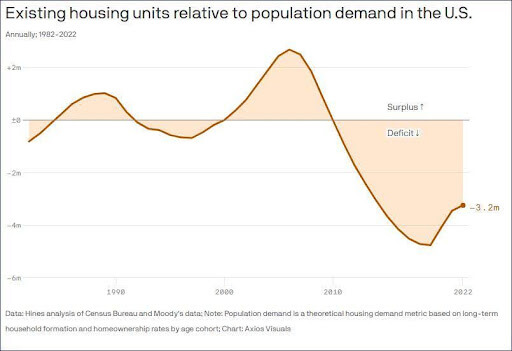
This is what is often referred to as a “sellers’ market,” in which there is little or no price sensitivity, and in many locations, there is aggressive bidding for properties as soon as they are listed for sale.
Old and at Home
Approximately 75% of the Boomer cohort (60–78 years of age) own their own homes.
For elderly, middle-income Americans who own property, a hot real estate market would seem ideal; homes that have been owned for some time have appreciated in value and will sell quickly. The problem comes on the other side of the transaction – what do I do now? Where can I go and what can I buy with the proceeds from the sale of my home? There have been many stories about seniors who get trapped in this very situation. Some earn too much to qualify for subsidized or designated low-income housing, but not enough to afford what is available.
Missing the Middle
In the 2019 Health Affairs article, The Forgotten Middle: Many Middle Income Seniors Will Have Insufficient Resources for Housing and Health Care, the situation for elderly housing was laid out in dramatic terms. Middle income seniors will increase in numbers from 2014 to 2029 from 7.9 million to 14.4 million. Most of the growth will be in the 75 to 84 years of age cohort—this is exactly when seniors need specialized housing and care. However, based on current purchase and rental rates, these age-qualified seniors are not financially qualified—they cannot afford what’s available today.
It would be simple to say, build more affordable, middle-income targeted seniors’ housing, but that’s an oversimplification. The barriers to this occurring include, but are not limited to:
- Construction costs – they’ve skyrocketed since 2019.
- Red tape – since 2015 according to the Federal Housing Trust Fund developers have only accessed a small amount.
- Discounted future income – incomes decline over time, so middle income seniors are not seen as “growth” markets by developers.
- Local regulatory and zoning constraints – most municipalities have laws and or regulations which discourage creative use of land and space by innovative developers.
This is the problem – what’s the solution?
The potential solutions to the “missing middle” in seniors housing in assisted living are, (most of them), easier said than done. The gap in available supply is not easily adjusted. Nevertheless, here are a few observations and rants in three categories.
- Development – No Cookie Cutters
As has been written about previously, the demographic market analysis performed for a feasibility study for seniors housing or assisted-living projects need to be far more realistic about who can afford what. Models of pricing have targeted the top 25% of the socioeconomic market.
Rethinking requires balancing three variables: construction costs, operating models and prices. Find the price point at which monthly rent is affordable while development and operational costs are covered, and NOI goals are achieved.
Leveraging subsidies and available tax credits such as grants, energy credits and tax credits like the low-income housing tax credits (LI HTC) have been used. These put the developer in a public-private partnership and collaboration with local governments and not-for-profit agencies in the marketplace area. The financial standards then become part of the development pro forma P&L.
Among the more affordable approaches is adaptive reuse of existing buildings. The barriers are manifold: life safety codes, zoning, adherence with various regulatory standards, historic registries and more!
On the flipside, the benefits are compelling including (often) location, community acceptance, access to infrastructure including transportation, and many others. Think outside the box and work in advance with individuals in the municipality and the local community to build your case.
All of the assumptions, from fit and finish, to service offerings need to be considered differently. Thinking outside the box here is what’s really called for, or perhaps better stated, thinking outside the cookie-cutter.
- Operations
Efficiency is the cornerstone of operating a middle-market seniors housing or assisted-living property. These principles are applied during the development of the physical design, but also in front-to-back digital management. Scope and deploy a CRM which fully integrates operations with marketing and sales, budgeting and planning, regulatory reporting and internal as well as external communications. Operational efficiencies need process standardization. In too many seniors’ housing in assisted living environments, operational managers rely on “experience” to guide or structure service delivery. This doesn’t lead to consistency and efficiency.
Staffing is enormously challenging. Borrowing from other service-based sectors such as hospitality and fast food, middle market projects can adapt and integrate recruitment, benefits and staff retention techniques. Social media marketing and digital communications techniques are definitely “outside the box” for many operators and developers.
Experience has shown that there is no one-size-fits-all for effective recruiting and retention, and that creative and adaptive segmentation, coupled with flexible scheduling and benefits design can have the greatest impact.
- Marketing
Sales and marketing needs to be as efficient and economic as operations. In best-in-class middle-market seniors housing or assisted-living projects, there is significant communications with thought leaders, agencies, social services, and healthcare providers and many others in advance during the development phase. Of course, sales lead generation, management and conversion is enabled through a fully integrated, customer relationship management (CRM) platform.
Digital marketing, built on effective use of an economical website and social media are pivotal to the overall efficiency paradigm necessary for middle market seniors housing in assisted living operations to succeed.
Websites that are optimized for organic search on keywords that adult children or seniors themselves might use become effective conversion engines for initial lease-up and ongoing wait-list development.
Social media pages and channels, along with curated digital platforms create excitement, build trust and confidence and provide bona fide information and answers to members of the community at large.
In Summary
The missing middle market and seniors housing and assisted living is large and growing. The obstacles to developing products and solutions to meet this growing demand are significant but not insurmountable. Innovative feasibility studies and development procedures can succeed in meeting this significant social and market-based demand.