

Hospitals, clinics as well as destination cities and countries are looking to improve their medical travel referrals. How can they effectively differentiate their services from the many hospitals, clinics and destinations vying for the same medical travelers? In our book co-written with Laszlo Puczko, The Marketing Handbook for Health Tourism answers are provided to these and other related questions. One of the important tools is perceptual mapping.
Perceptual mapping helps with medical tourism marketing by analyzing and visualizing the perceptions of different medical travel destinations, facilities, and services. Here is how perceptual mapping works.
Positioning: The dominant opinion of your customers and consumers is your “brand position”. Destinations for medical travelers can use perceptual mapping to determine how they are positioned relative to competitors. Hospitals and clinics can leverage this analytic tool to determine how they compare to other providers. By mapping factors such as perceived quality of care, cost, reputation, and available services, providers and destinations can determine how best to reposition or make changes. This process helps customize marketing tactics to target specific referral sources and patient segments.
Quality: Perceptual mapping shows providers their perceived service quality from the perspective of patients. By using measures such as patient satisfaction, marketing, physical location and facilities and follow-up care, hospitals and clinics can identify areas of strengths and weaknesses from the consumer/customer’s perspective. These insights can be used to manage the expectations of referral sources and consumers themselves.
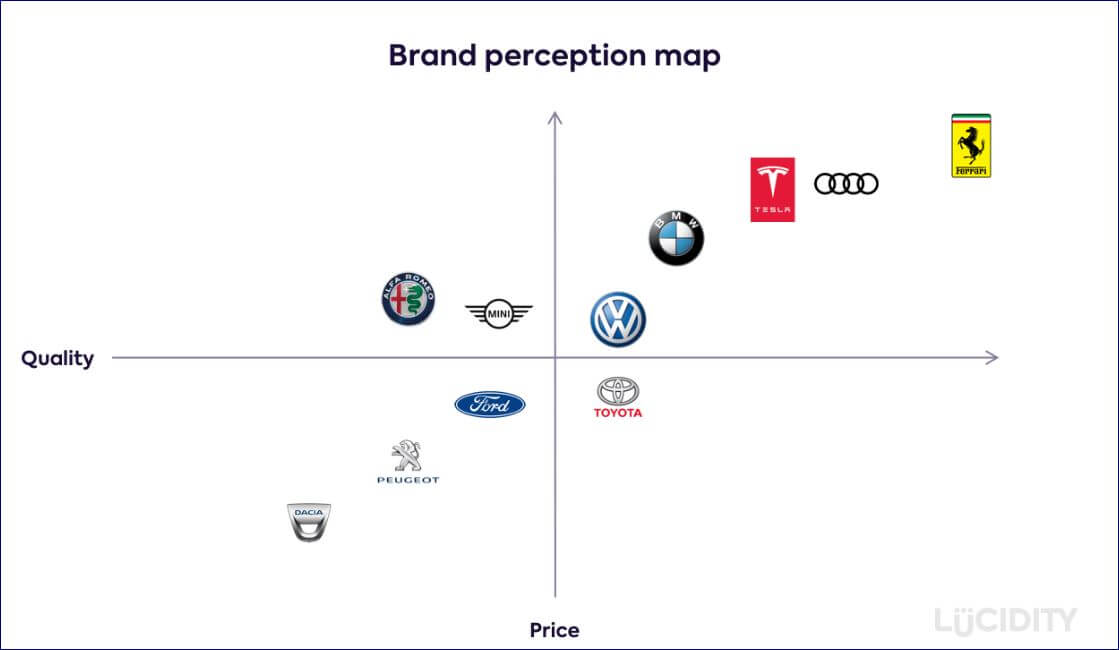
As an example, the “Brand Perception Map” shows how price and quality are related in the automobile markets. In hospital services, the “Ferrari” brand would be an ultra-exclusive hospital in, for example, Monte Carlo while the “Peugeot” brand might be an affordable provider in India or Thailand. Understanding where your brand is in the competitive profile enables you to make informed decisions about marketing steps, and how to measure success.
Segmentation: Medical tourism is not one market, but is a highly fragmented set of markets, which need to be segmented for effective marketing and lead management. The motivations, expectations and desires of parents of a 10-year-old boy with life-threatening brain cancer are completely different from that of a middle-age man seeking a hair transplant. Perceptual mapping segments the markets. By identifying clusters of referral sources or consumers with similar preferences and needs, destinations and care providers can target marketing messages and tactics to the distinct expectations and requirements of each segment.
Competitive Position: Among the best uses of perceptual mapping is the analysis of the competitive/comparative landscape and identification of real competitors. Very often, clients ask how they compare to this or that famous hospital, to another well-known destination which may or may not be actual competitors. Perceptual mapping weighs factors such as brand reputation, location, clinical specialization and others, allowing reliable analysis of the strengths and weaknesses of competitors and viable methods to differentiate themselves for competitive advantage.
Perceptual mapping also contributes enormously to successful strategic planning. By visualizing the relationships among important attributes and how specific attributes contribute to perceptions and decisions, more rigorous choices can made about resource allocation, service line changes or enhancements, and overall marketing positioning.
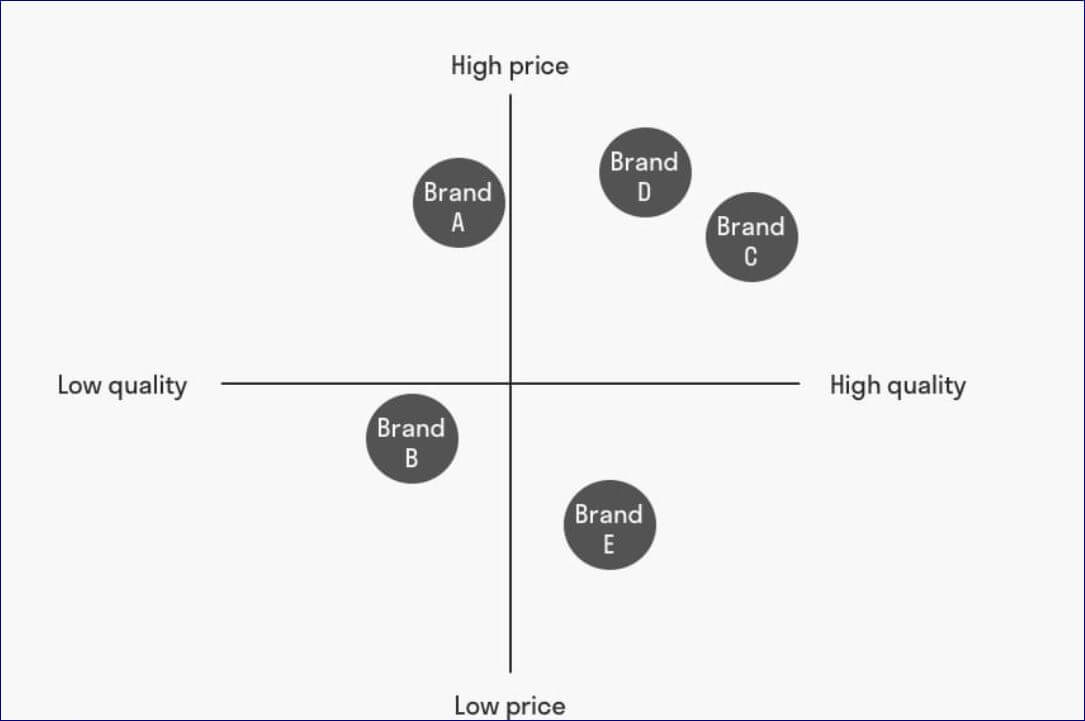
Perceptual maps often reveal what leadership may have difficulty admitting or accepting. For example, in this map of hospital brands, hospital Brand A (our client), while perceived as high Price, is perceived as lower Quality than Brand D, C and E. This suggests aggressive marketing methods to improve its perceived Quality, moving its position on the map to the right and closer to, or even past, hospital Brand D and C.
Steps in Perceptual Mapping
How do you produce perceptual maps? Here are the steps.
Select Variables: Determine how the target audience judges or evaluates you. If you represent a destination, then overall reputation, easy physical access, and costs may be important. If you work with a clinic or hospital, the variables might be service line features such as state-of-the-art technology, reputation of the doctors, price, brand image, cultural or ethnic alignment among other relevant factors.
Choose Competitors: One of the most important variables is / are the competitors. It is important to select the most appropriate competitors for comparison in the perceptual map. These need to be relevant and represent the real competitors in your market.
Collect Data: Survey and/or interview referral sources or consumers to learn how they perceive the identified variables and your brand. The most rigorous methods use Likert scales, ranking questions and other techniques to quantify perceptions. Available data such as actual customer / consumer satisfaction, market share, and service-line volumes can also be used.
Map the Data: Perceptual maps are two-dimensional graphs with each axis representing one of the variables identified in step 1. The position of each competitor or product is also plotted based on the perceptions of the referral sources or the consumers. Software such as Excel or SPSS can produce perceptual maps.
Analysis: Analyze the perceptual map to see patterns among the variables, looking closely for how they group together, or “cluster”. How brands and variables cluster and occupy similar / different positions are particularly important, as these help identify gaps in the markets.

For example, this perceptual map shows how selected destinations compare in clusters based on emotional and physical variables such as excitement, welcoming, beauty and safety.
Reposition: The perceptual map shows where your service line, destination, and brand currently plot, relative to competitors. Does this align with your marketing objectives among your targeted referral source or consumer segments?
Develop Marketing Tactics: You may decide that your current position is perfect, or that you want to change (“reposition”). The perceptual map offers specific guidelines about how to change marketing tactics.
Rinse & Repeat: Change is a constant in the medical travel and health tourism markets as recent geopolitical and global realignments demonstrate. Consumer perceptions and market dynamics will change, and perceptual mapping will help you adjust your strategy and tactics to stay competitive.
Interested to learn more about perceptual mapping and how Stackpole & Associates can assist with developing this tool for you? Contact us today.
Irving Stackpole is President of Stackpole & Associates, a marketing, market research and training firm at www.StackpoleAssociates.com. He can be reached for direct consultations at: istackpole@stackpoleassociates.com. Or contact his mobile / WhatsApp: +1-617-719-9530.