
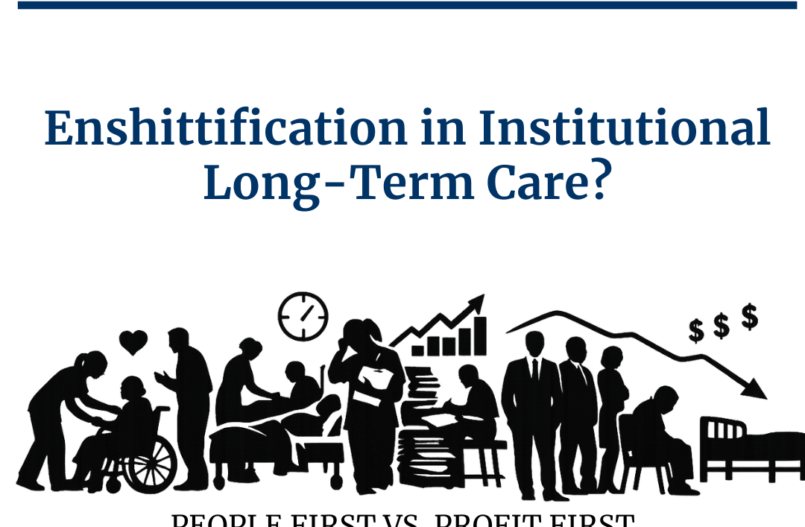
The concept of understaffing has been weaponized at both ends of the long-term care value chain. The question is: given the scale of demand emerging from aging demographics, how long will this continue?
When Rhetoric Masqueraded as Solutions
In the 1990s, my consulting firm conducted a large-scale survey of residents and staff across a national chain of long-term care centers — more than 250 facilities and over 10,000 employees. One recurring theme from residents was their empathy for hard-working staff, whom they believed were perpetually “understaffed.” In follow-up interviews, it became clear they had learned this from the staff themselves. When nurses and aides ran behind on tasks, they’d apologize with, “Sorry, we’re short-staffed today.”
At the time, we treated this as a perception problem. My team designed customer service training that coached staff to say instead, “Do you need anything else? I have the time.” We believed we could paper over the real issue with better rhetoric.
Today, that seems naïve.
Is long-term care profitable?
Forgive me if this seems like a non-sequitur, but bear with it.
A stable workforce is strongly associated with higher profitability in service-based industries overall, primarily through higher productivity and quality, and lower costs.
Yet the record of PE ownership in long-term care tells a more complicated story. PE-owned nursing homes tend to show stronger short-term financial performance than other investor-owned centers, but research consistently finds this does not translate into better care. The financial advantage appears to stem from cost-cutting, debt loading, and fee extraction—not durable operational improvement.
In short, PE ownership may improve reported margins or investor returns while simultaneously undermining a center’s ability to reinvest in care or sustain quality over time.
Understaffed, Overworked, and Out the Door
Given all of that, one might expect frontline workforce retention to be a top strategic priority—especially among for-profit operators. It isn’t.
Frontline turnover in long-term care is abysmal, costing the sector hundreds of millions of dollars annually, to say nothing of the brand damage. If there’s a sector in the United States with a worse public image than long-term care, I’d like to know what it is.
Here’s the kicker:
Not-for-profit nursing homes consistently show better workforce stability than for-profit centers, even after controlling for resident mix and facility size. In a recently completed large-scale longitudinal analysis of a for-profit chain, we found that workload burden was the single most significant causal factor in turnover across the entire portfolio.
Give staff too much work, and they leave. Full stop.
Enshittification or the Slow Decay of Care Quality
Enshittification, or platform decay, is a process in which products and services decline in quality over time. Initially, providers create high-quality offerings to attract users; then they degrade those offerings to better serve business customers; and finally, they degrade their services for both users and business customers to maximize short-term profits.
Cory Doctorow coined the term in 2022 to describe how platforms that begin with genuine responsiveness gradually, as users grow dependent, strip away value to maximize extraction.
Has it been happening in long-term care? I may have been too naïve to see it for what it was.
As a society, the United States — along with the UK and other countries approaching a demographic cliff — faces growing dependence on long-term care. Even optimistic projections about improved healthspan don’t change the underlying reality: age-related chronic illness is already generating higher levels of dependency and social burden.
Where Do We Go From Here?
Realistic options are few and none are easy.
The optimistic scenario is that PE firms and other institutional owners wake up to the problem and invest in evidence-based, technology-enabled workforce strategies that actually meet the needs of residents and families.
The more likely scenario is that enshittification continues, staff keep churning, and residents and families are left fighting providers for adequate care.
The third possibility — bleak, but worth naming — is a full collapse of the US healthcare system as it currently exists, followed by a fundamental rewrite of the social contract, with federal and state governments taking direct responsibility for long-term care provision.
The question is which of these futures we’re willing to accept.
Enshittification isn’t inevitable… but the clock is ticking. Which future does your organization want to be part of?. Let’s talk. Contact us: istackpole@stackpoleassociates.com, or +1-617-719-9530 (WhatsApp or mobile).